
Miami County’s Three-Day Feed Finding
No official rolling 72-hour Miami County release feed was found as of July 31, 2026. The county’s public JusticeWeb portal is a current-custody roster. It does not offer a demonstrated three-day window, release archive, release-date filter, or release-disposition filter. Its landing page supports name searches and A–Z browsing, but those controls search who remains in the listed jail population.
A longer period cannot be rebuilt by collecting names that vanish from the roster. Miami County operates two Sheriff facilities, and movement between them can change how a person appears without ending county custody. A person can also be conveyed to the Ohio Department of Rehabilitation and Correction, sent to another jail, or picked up on a detainer. The Sheriff release or movement entry is needed to identify the actual result.
Build a Miami County Release Window
The verified local route is a time-bounded public-record request for an existing log or export. Choose an exact start and end timestamp that spans the intended three days. Calendar dates alone can create doubt about whether midnight is included. If the purpose is to cover a weekend, state the first date and time before the weekend and the final date and time after it.
- Define one exact seventy-two-hour interval, including the time zone if the request could be read another way.
- Ask Miami County Sheriff Records for existing release or movement log entries whose recorded event time falls within that interval.
- Request maintained names, booking numbers, release timestamps, dispositions, and receiving agencies or destinations.
- Ask for the record in the format in which it is kept. Do not require a custom analysis or a new classification.
- Review each disposition and follow any transfer or conveyance to the named receiving authority.
Requests may use the county public-record form, the email linked by Sheriff Records, a phone call to (937) 440-6085, or an in-person request at 201 West Main Street, Troy, OH 45373. The office’s posted hours are Monday through Friday, 8:00 a.m. to 4:00 p.m., excluding legal holidays.
Note: Request an existing record for a fixed interval so the office can respond without being asked to create a new report.
Miami County 72-Hour Record Fields
No online Miami County three-day list exposes a verified set of release fields. The following are fields to request from the custodian, subject to what is maintained and public. The destination and disposition are vital because they show whether the event ended confinement or merely shifted the person to another authority.
| Requested field | How to read it |
|---|---|
| Person name | Starting identity field that must be checked against a lawful second identifier. |
| Booking number | Separates one jail episode from a prior or later booking for the same person. |
| Release timestamp | Places the Sheriff event inside or outside the selected three-day interval. |
| Release disposition | May identify bond, recognizance, time served, sentence completion, dismissal, or transfer. |
| Receiving agency or destination | Shows when county custody ended through conveyance or pickup rather than community release. |
| Case reference | Connects the jail event to a Miami County court order or judgment entry. |
Do not assume every listed field exists. Ask Sheriff Records to identify the responsive document and any redactions. If no single “release reason” field is kept, request the existing record that best reflects the disposition. Miami County’s adopted retention schedule, rather than online visibility, controls how long the underlying record remains.
Miami County Weekend Release Review
A seventy-two-hour request is useful when a likely event falls near a weekend or legal holiday. Court action, Sheriff processing, transport arrangements, and system updates do not all share one timestamp. A judgment entered before the weekend may be followed by later physical processing. Conversely, a later court docket entry can document an earlier event. The wider interval helps capture the jail’s own recorded event without guessing which calendar day controls.
Miami County Sheriff Records does not list legal holidays as regular office hours. A request submitted during a closure will not become an instant feed. Allow the office a reasonable response period and ask for the kept record. For an urgent status question, call inmate information at (937) 440-3961 or Downtown Jail Control at (937) 440-3971. Phone confirmation is useful, but a written record is stronger when the exact time and disposition matter.
Do not infer that a weekend caused a delay unless the record or agency says so. No official Miami County weekend-release rule was found. The broader period is a search method, not an operational claim.
Miami County Roster Retention Limits
The Miami County roster labels its subjects as persons currently in custody and states a 30-minute update frequency. That cadence is not a guaranteed event-posting deadline. The public page’s durable fields are its name controls, provider details, phone, interval, and timestamp. Captcha prevented responsible verification of detail fields such as a photo, charge, booking date, or facility location, so those features should not be promised.
The official Miami County roster capture below shows why it is a present snapshot, not a three-day release product.
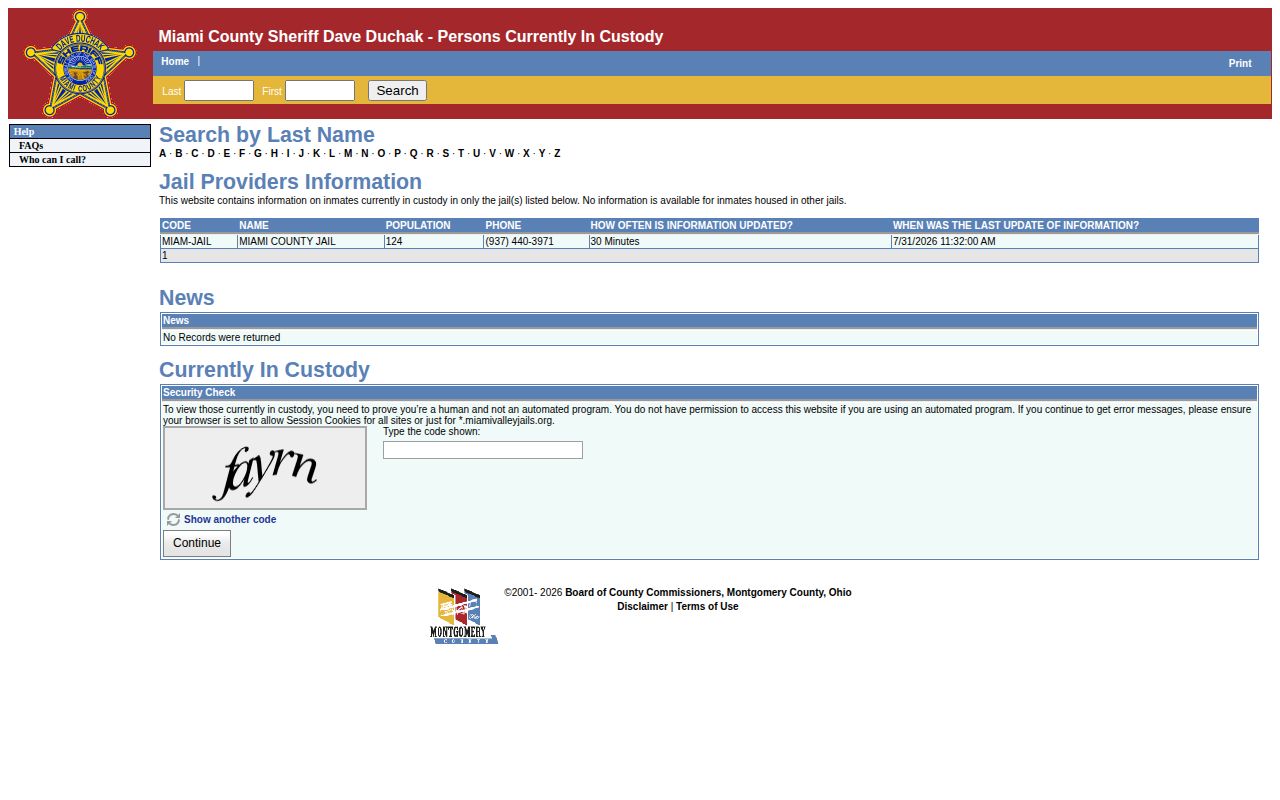
A timestamped screenshot can document what the roster reported at one moment. It cannot identify the later disposition or prove that an absent person left all custody.
Online retention and legal retention are different. The roster does not represent an after-release retention window because it is current-only. Underlying Sheriff records may remain under Miami County’s RC-2 schedule after the web entry disappears. Ask for that schedule if older records matter.
Note: The roster’s stated refresh interval should be recorded as a claim by the provider, not treated as a release-time guarantee.
Reconcile Miami County Release Events
A three-day result can contain several kinds of custody endings. Bond and recognizance are pretrial outcomes. Time served or sentence completion ends an ordered custody part, though supervision or other duties may follow. A dismissal can support release in one case while another case supplies a hold. Transfer, conveyance, and detainer pickup end the Sheriff’s custody but usually place the person with another agency.
Miami County CourtView access helps identify the legal basis. Review all known Common Pleas and Municipal cases, not just the first name result. A signed order can show bond, dismissal, sentencing, jail credit, community control, judicial release, or conveyance. It does not necessarily show when Sheriff processing ended. Pair it with the release entry.
When the disposition names ODRC, use the ODRC Offender Search. Search by offender number when available or by name with Miami as County of Commitment. The state search’s Released status is for ODRC custody, not people who merely left Miami County Jail. A person conveyed to prison should not be placed on a community-release list.
Note: A three-day review can span several legal events, so match each Miami County disposition to its own booking and case.
One Miami County Release Check
A county-wide interval request and a one-person inquiry are different tasks. For one person, first ask which authority last held the person. Check the current roster, call the jail, and request the named booking episode. Compare date of birth, booking number, middle name, case number, or another lawful identifier because common names can produce false matches.
Ohio VINE can provide a person-specific event or alert for participating county and state systems. It is not a complete export of everyone who left Miami County custody. Preserve the alert time and event wording, then confirm the event with the reporting agency. If it says transfer, follow the destination. The Miami County released-inmate records page lays out the fuller named-person verification route.
Miami County Release Source Roles
Each official source has a defined job. Treating them as interchangeable creates bad conclusions, especially across a three-day span with several court and custody events.
| Source | Best use | Key limit |
|---|---|---|
| Sheriff period request | Potential county-wide chronological release or movement entries | Only fields and records that the office maintains and can disclose |
| Current jail roster | Snapshot of who is reported in custody at its update time | No release archive or proven three-day filter |
| CourtView | Legal orders, case dispositions, bond, sentencing, and conveyance | No demonstrated release-period filter or physical-exit time |
| Ohio VINE | One-person custody event and notification | Not a certified county-wide release ledger |
| ODRC search | Ohio prison release and supervision status | Does not cover ordinary county-jail release |
Custody outside the county requires a different official route. The BOP locator covers federal prison records, while the ICE detainee locator is a current or recent immigration-custody tool. Neither is a Miami County three-day release list. The Ohio eSORN registry applies only to people with a continuing legal registration duty and cannot stand in for a release search.
For a shorter period focused on the current day, follow the Released Last 24 Hours request method. Do not simply shorten a roster comparison. Set a precise interval and ask the Sheriff for the kept release or movement record through its official records channel.