
MCIF Release and Transfer Paths
Miami County Incarceration Facility, often shortened to MCIF, is the lower-security part of the Sheriff's two-building jail system. Ohio law and county planning materials limit it to minimum-security or lower classifications. It supports weekend and work-release functions. Those roles differ from the downtown Miami County Jail, which performs full booking, intake, and release operations and holds higher classifications.
A person can leave MCIF after completing a sentence or program, through court-authorized release, or through an operational transfer. The person may return to the downtown jail, move to another county, or enter another agency's custody. A work-release assignment also does not mean the person has been fully discharged from custody. Work release permits approved activity under set terms while the county custody or sentence framework continues.
The Sheriff's movement or release record should state the event and destination to the extent those fields are maintained. Pair it with the signed court order when the legal basis matters. If a record says “transfer,” “conveyance,” or names another agency, confirm receipt there. Never turn a building departure into an unsupported claim of community release.
MCIF departure is not always final release. Ask whether the person completed custody, returned downtown, or transferred to another authority.
Confirm an MCIF Release
JusticeWeb presents the county provider as “MIAMI COUNTY JAIL,” not as a reliable building-by-building history. Its landing page is expressly limited to people currently in custody and states a 30-minute update interval. It does not offer a verified release archive, a 24-hour or 72-hour release list, or a field explaining moves between MCIF and downtown. If a name disappears, save the query time, then seek the actual movement or release record.
- Search the Miami County current-custody roster and note its displayed update time. A hit confirms only the reported current snapshot.
- Call MCIF Control at (937) 440-3490 for an operational status question. The MCIF office number is (937) 440-6095.
- Contact Sheriff Records at (937) 440-6085 and request the existing movement, booking, and release records for the identified custody episode.
- Ask for the release timestamp, exact disposition, and receiving agency or destination if maintained. Do not ask staff to create a custom report.
- Check the appropriate Miami County court case for the signed order. Follow ODRC or another jail when the record shows a conveyance or transfer.
The current roster and the release record answer different questions. The roster shows who the provider reports as held at a changing moment. The Sheriff record documents the completed event. CourtView can show sentence completion, time served, community control, bond, dismissal, or a conveyance order, but a court filing time does not prove when the physical processing ended.
Ohio VINE may supply a person-specific custody-change alert for a participating county jail. Treat it as notice, not as the permanent file. Transfer, release, escape, and death are separate event types. Confirm an MCIF event with the Sheriff and follow any named receiving authority.
Note: Record the source, query time, and exact event label because live roster and notification information can change after each check.
MCIF Release Records and Contacts
MCIF has separate office and control numbers, while the central Sheriff Records office handles public-record requests for the county jail system. Call Control for time-sensitive operational questions. Use Records for a durable document that states how the custody episode ended. The county accepts requests through its form, through the email linked from the records policy, by phone, or in person.
Miami County Incarceration Facility
2042 North County Road 25A
Troy, OH 45373
MCIF office: (937) 440-6095
MCIF Control: (937) 440-3490
Miami County Sheriff Records
201 West Main Street
Troy, OH 45373
Phone: (937) 440-6085
Hours: Monday-Friday, 8:00 a.m.-4:00 p.m., excluding legal holidays
A focused request should give a full name, another lawful identifier, and a narrow date range. Ask for any existing MCIF movement entry, admission or transfer record, release date and time, release reason or disposition, and destination or receiving agency if maintained. If a booking photograph is relevant, identify it separately. MCIF's lower-security assignment can be one part of a longer county booking episode, so state whether the request concerns a move into MCIF, a return downtown, or the final end of Sheriff custody.
The Sheriff records policy says records are open for prompt inspection and copies within a reasonable time during its listed hours. It quotes five cents for a single-sided paper page and ten cents for a double-sided page. Digital requests under 20 pages have no charge; larger ones use the page rates and are prepaid. Costs for photographs, video, other media, and mailing are quoted. Redactions and exemptions may apply. Ask the office to identify the controlling retention schedule if an older entry cannot be located.
MCIF Work Release Role
MCIF is not simply a second name for the downtown jail. Its minimum-security limit shapes who can be assigned there, and its weekend and work-release functions create movement patterns that a public roster cannot fully explain. A weekender may serve court-ordered custody in intervals. A work-release participant may leave for approved activity while remaining subject to the facility's rules and custody framework. Neither condition should be called discharge unless the official record says the sentence or custody component ended.
The official Miami County jail-information page provides the Sheriff's current public description of the two facilities:
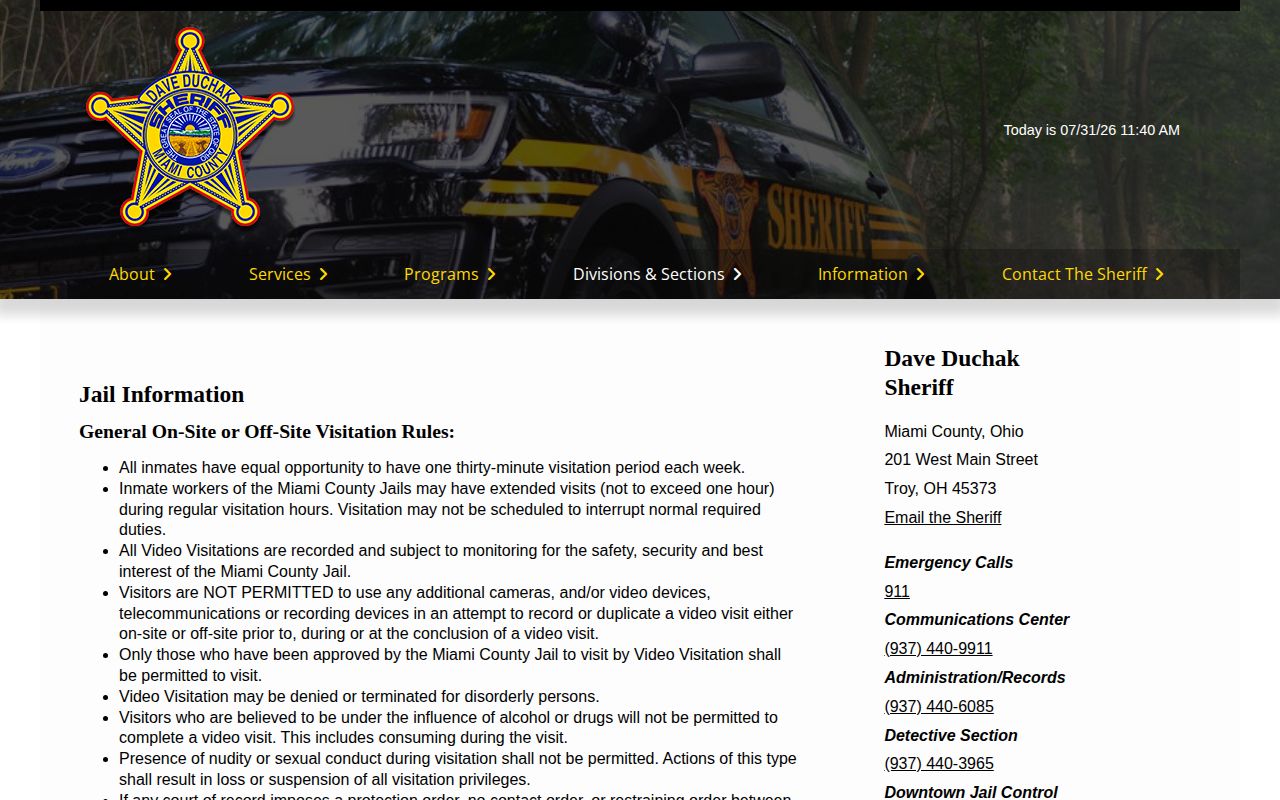
The screenshot establishes the official facility source. It does not supply a person-level MCIF release result. County materials have described a maximum capacity if fully funded and staffed and a reopening configuration with funded pods. Those numbers are conditional and time-sensitive, so they should not be treated as a guaranteed live population or certified capacity.
| Event | What it can mean | Best confirmation |
|---|---|---|
| Completion | The ordered MCIF custody or program component ended | Sheriff release record plus court entry |
| Return downtown | An internal move within the Sheriff's two-building system | Sheriff movement entry and Jail Control |
| Agency transfer | Another jail or authority received custody | Disposition plus receiving agency |
| Work-release movement | Approved activity while custody terms continue | Facility instructions and court order |
MCIF Release History Matters
MCIF opened in 1999 after a federal consent decree tied to overcrowding at the downtown jail. It closed during the 2009 recession and reopened in 2013 as a minimum-security facility. Downtown dates to 1972. This local history explains why Miami County has two distinct buildings under one Sheriff system and why a building-level absence can occur without a community release.
The official jail history notes that MCIF was originally intended to house minimum-security, work-release, weekender, federal, and out-of-county populations. That statement describes original intent. It is not proof of a current federal contract, an active ICE agreement, or a present federal population. No official evidence reviewed for this build established that MCIF now operates as an ICE detention facility.
If a particular record names the U.S. Marshals Service, BOP, ICE, ODRC, or another county, follow the named agency for that person. Geography alone does not define the legal custody system. A federal detainee can be held in a contract site, yet an old design purpose does not establish that arrangement today.
The distinction also prevents false conclusions about the roster. JusticeWeb's countywide provider label may remain the same while the person's building assignment changes. The Sheriff movement record is the proper source for the path between downtown and MCIF.
MCIF Release Planning Evidence
The 2025 Jail Needs Assessment combines classification rules, intake and release workflow, admissions, average stay, release-time distribution, and facility planning in one local source. Those findings give useful system context. They do not publish a recent-release feed, a guaranteed exit location, or a daily MCIF pickup schedule.
For 2023, the assessment found that county releases were most frequent between 7:00 a.m. and 4:00 p.m. It did not promise those hours for a given person or separate each MCIF event from downtown processing. Annual county admissions for 2021 through 2023 ranged from 1,814 to 1,968, while the 2023 average length of stay for people released that year was 33.0 days. These are historical system measures. They cannot predict one MCIF stay.
Miami County Transit is demand-response rather than a fixed jail shuttle. County information says anyone may ride, county trips cost four dollars one way, advance booking is preferred, and same-day service is not guaranteed. The transit office is numerically near MCIF on North County Road 25A, but no official source promises an MCIF pickup. Call (937) 335-7433 and schedule directly.
Property return, exact exit location, and waiting instructions were not published in the reviewed materials. MCIF Control should answer those practical questions for an identified release. A planned ride should be confirmed with both the facility and transit service because release processing and transportation availability can change.
Note: Historical assessment findings describe county operations, not a firm MCIF release hour, exit door, or transportation commitment.
Read MCIF Release Terms Carefully
Release terms answer separate questions. “Time served” can end the custody term while community control follows. Community control is local court supervision often called probation. “Transfer” ends MCIF's physical custody but not confinement. “Discharge” should be used only as the responsible record uses it. A detainer lets another authority take custody, so the first agency may record a release while the person remains confined elsewhere.
For a complete finding, match the person, the facility, the event label, and the destination. Check every known case for a hold or later order. Use the Sheriff's timestamp for physical processing, the signed court entry for legal authority, and the receiving agency for continued custody. The downtown Miami County Jail release page explains the booking and intake side of this two-building path.
- Movement record
- A Sheriff record of a move within or beyond the jail system.
- Release disposition
- The maintained reason or outcome attached to the end of a custody episode.
- Detainer
- A hold or request through which another authority may receive the person.
- Final discharge
- The end point stated by the responsible authority, which may occur after physical jail release.