
Miami County Parole Versus Probation
Parole, post-release control, and county probation can all follow a period in custody, but they do not mean the same thing. Parole generally applies to a parole-eligible prison sentence after an Ohio Parole Board decision. Post-release control is a term of state supervision required by law after certain prison terms. Both are administered by the Ohio Adult Parole Authority, or APA, within the Ohio Department of Rehabilitation and Correction. Miami County probation is local. The Common Pleas Court calls it community control and has used its own Adult Probation Department since June 2020.
The source of the sentence tells you where to verify supervision. An ODRC prison record points toward APA. A Miami County Common Pleas judgment that imposes community control points toward Adult Probation. A person may have a more complex history involving both systems, so read the court docket and state record together. Do not assume that the everyday word “probation” identifies the supervising office.
| Supervision type | Who imposes it | Where to verify |
|---|---|---|
| Parole | Ohio Parole Board under a parole-eligible sentence | ODRC Offender Search, Board record, and APA contact shown on the record |
| Post-release control | Ohio law and the prison sentence | ODRC status and the sentencing entry |
| Community control or probation | Miami County court judgment | CourtView, the signed order, and Miami County Adult Probation |
- Parole
- Conditional release from a parole-eligible prison term under APA supervision.
- Probation
- A common name for court-ordered community control managed by the local probation department.
- Post-release control
- State supervision after specified Ohio prison terms under R.C. 2967.28.
- Discharge
- The official end of a sentence or supervision term, not merely release from a jail or prison.
Verify Miami County Release Supervision
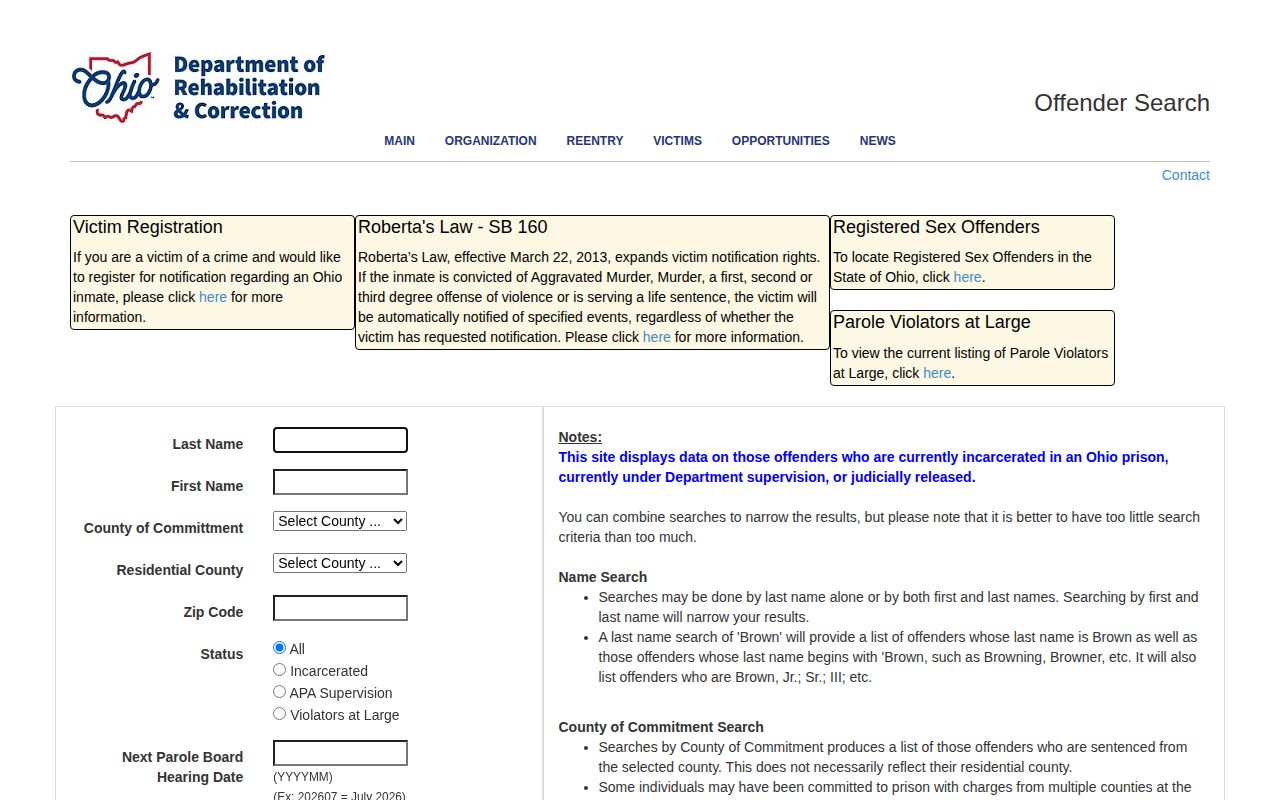
Begin with the authority that last held or sentenced the person. The ODRC Offender Search has separate status choices for Released, APA Supervision, and Violators at Large. Its County of Commitment field means the sentencing county, not present residence. Residential County and ZIP apply only to APA Supervision and Violators at Large queries, and an address shown there is a last recorded address rather than a live location.
- For a state-prison case, search by offender number when known. Otherwise use the name and compare all available identifiers.
- Select APA Supervision to check parole or post-release control. Search Released separately because leaving prison and ending all oversight are different events.
- For local community control, open Miami County public access, choose the correct court division, and retrieve the signed sentencing or judgment entry.
- Call Miami County Adult Probation for an appropriate public confirmation. Case notes and private supervision details are not made public just because the court docket can be viewed.
- Record the date and time of each search. If the two channels conflict, ask the agency named in the latest official record.
The ODRC search controls are visible on the official offender-search page. The image shows why selecting the correct status matters before drawing a conclusion.
A county probation result will not appear merely because APA has a statewide search. The court judgment remains the key local source.
Note: A Released ODRC status does not by itself mean the person has completed parole, post-release control, or every other legal obligation.
Miami County Probation Office
Miami County Common Pleas established its Adult Probation Department in 2020 after ending its prior arrangement with APA. The official department page reports a chief, three field officers, support staff, and more than 300 court-ordered people under supervision. Those figures describe the local program. They do not identify any one person's current status.
Miami County Adult Probation
Safety Building, third floor
201 West Main Street
Troy, OH 45373
Phone: (937) 440-6010
Fax: (937) 440-6034
Commonly stated hours: 8:00 a.m. to 4:00 p.m.; verify availability
Use the official Adult Probation page for current department information. The same Safety Building also houses the Clerk, but those offices have distinct roles. The Clerk maintains the case docket and filed orders. Adult Probation administers the community-control term. Ask the Clerk for an order and the department only for the public status it can lawfully confirm.
Miami County APA Release Status
No reliable Miami-specific APA field-office address was verified in the research. Reporting instructions can change and may be assigned outside the county. For that reason, use the office or contact data on the person's current ODRC record rather than sending someone to a guessed Dayton-area location. State supervision is individual and time-sensitive.
R.C. 5120.21 makes the full APA file nonpublic but allows limited disclosures, including supervision status. Ohio's Public Records Act also excludes records tied to many probation, parole, and post-release-control proceedings. A narrow request for status is more appropriate than asking for an officer's full case-management file. The post-release-control statute explains the legal framework, while the actual sentencing entry establishes what applies in a given case.
Note: Follow the reporting instructions on the current official record; an old office address can cause a missed appointment or false assumption.
Miami County Supervision Violations
Conditions can include reporting, travel limits, treatment, conduct rules, or other terms stated by the court or state authority. A high-level docket entry may show that conditions exist without exposing private case notes. A claimed violation can lead to a hearing, changed conditions, a warrant, or a return to custody. It does not itself prove a new offense or establish guilt.
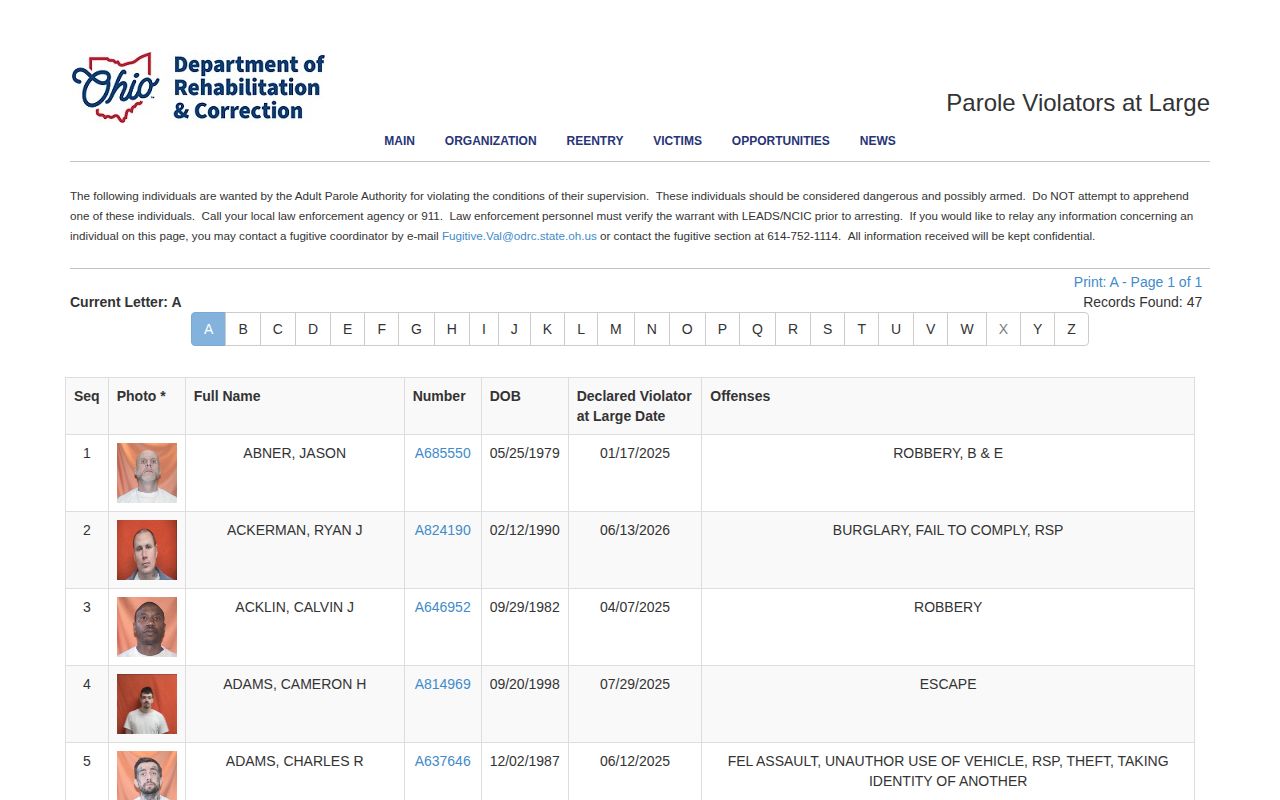
For APA cases, the official Parole Violators at Large listing is the narrow statewide source. It identifies people whom APA reports as wanted for alleged supervision violations. It does not give a safe, current physical location, and the last recorded county or address should never be read that way. Safety action belongs with law enforcement.
The official PVAL page illustrates that this is a specific subset of state supervision, not a list of all people on Miami County parole or probation.
A person absent from PVAL may still be on APA supervision. Likewise, a PVAL entry does not prove that the person is booked into Miami County Jail.
Miami County Supervision Release Alerts
Ohio VINE adds a notification channel, but it should not be confused with a parole or probation case file. State materials describe release, transfer, escape, and death events for participating county jails, with ODRC release and parole-review events in the state corrections channel. Each event has a narrow meaning. A transfer alert may show that Miami County custody ended while another agency took control. It does not establish a return to the community.
Search the specific person in Ohio VINELink, compare the reporting agency and lawful identifiers, and preserve the event wording and time. Then confirm a county event with Sheriff Records or a state event with ODRC. Ohio warns users not to rely on VINE alone. The service does not cover federal BOP or ICE custody merely because the person has an Ohio connection, and a notification does not change a court or supervision order.
A registry is different again. Ohio eSORN covers only people with a continuing statutory registration duty. It is not a directory of all Miami County released people, parolees, or probationers. An absent result has no general meaning. Use the docket, ODRC status, or Adult Probation channel that matches the sentence.
Note: Preserve a VINE notice as a timely lead, then confirm the event and ongoing supervision through the agency responsible for that custody record.
Miami County Parole Hearing Records
A hearing date, parole eligibility, a Board decision, physical release, and discharge are separate milestones. The verified official schedule route is the Next Parole Board Hearing Date field in the ODRC search. Enter a year and month in the format requested by the live form, then open the matching person's record. That confirms current scheduling only. It does not prove parole was granted.
No working standalone Ohio hearing calendar or decisions-results page was verified. Legacy links failed, so labels such as granted, denied, deferred, or rescinded should be quoted only when they appear in an actual official document. R.C. 2967.13 governs parole eligibility for covered sentences. Eligibility opens the chance for consideration; it does not order release. Consecutive terms and sentence type may change the analysis.
For a complete check, compare the month search, the person's ODRC detail, the Miami County sentence, and any Board document. Removal from a schedule can reflect a changed date and must not be treated as a decision. The Miami County inmate release date page explains why a planned date can move before actual departure.
Miami County Supervision Discharge
Release from a cell is not the same as final discharge. State supervision ends only through the official APA or sentence process. Local probation ends under the Miami County court's order and department procedure. The exact end point can matter when reading a later docket or an older release record, but no one should calculate it from a projected date alone.
For local probation, review the full case chronology for termination, revocation, extension, or final entries. For APA, use the official ODRC status and seek the limited confirmation the agency can provide. A VINE custody alert can mark release or transfer, but VINE is not a permanent supervision ledger. The Miami County released-inmate search and records path helps reconcile the Sheriff's physical-release entry with the court or state record.
A clear verification states the source, query time, exact status, and limits. That protects the distinction between being out of custody and being free from all supervision.