
Miami County Scheduled Versus Actual Release
A scheduled or projected release date is a calculation made before the person leaves custody. The actual release date records what happened after processing was complete. Those dates can differ. Credits may change, a court may issue a new order, an outside agency may place a hold, or a transfer may occur instead of release to the community. For that reason, a screen showing a future date is not proof of the time or place of physical exit.
Pretrial and sentenced custody must also be separated. A person held before trial usually has no sentence term from which to compute an inmate release date. Bond or recognizance may authorize release, but staff must process the order and check other cases or detainers. A sentenced inmate has a judgment, yet even that date may depend on jail-time credit, sentence structure, earned credit, and later official action.
The Miami County released-inmate search and release-record route is the stronger source after the event because it distinguishes community release from transfer or conveyance.
Find a Miami County Release Date
Start by deciding whether the person is in Miami County Jail, the Miami County Incarceration Facility, or an ODRC prison. The county roster is current custody only and has no verified projected-date field. ODRC has a statewide offender search, but the research did not verify the exact label used for a future date on an individual detail record. Do not substitute “projected,” “expected,” or “tentative” for the live wording.
- Identify the last custody authority and the case that caused confinement. A county booking and an ODRC prison term use different calculations.
- For a pretrial county case, review the Miami County court docket for bond, recognizance, dismissal, or another order. Then call the jail because an order is not a physical-exit timestamp.
- For a county sentence, obtain the signed sentencing entry and verify the court-awarded jail-time credit. Ask Sheriff Records what date its existing record currently calculates.
- For an Ohio prison sentence, use the ODRC Offender Search. Search by offender number when possible, open the correct record, and transcribe the exact status and date labels.
- Check other case numbers, warrants, detainers, sentence components, and supervision terms. Record the time of the query and confirm again near the stated date.
The official ODRC search page shows filters for name, offender number, County of Commitment, status, and Next Parole Board Hearing Date.
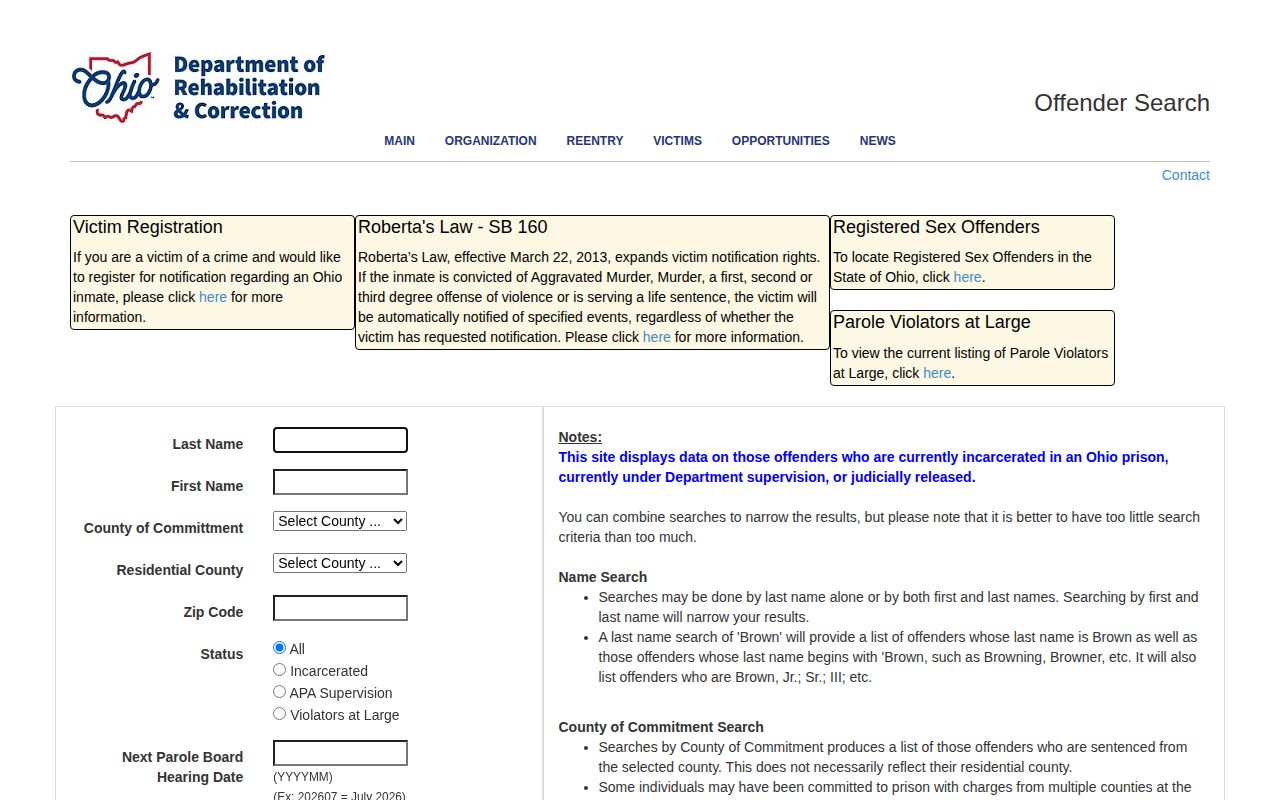
Miami as County of Commitment means the sentence originated there. It is not a live address, and a multi-county sentence may be indexed under the first recorded county.
Miami County Jail Release Calculations
For a definite Miami County sentence, the court judgment supplies the term and awarded jail-time credit. Sheriff Records can identify the date shown in the jail record and whether another maintained entry affects it. Do not calculate the date from the sentence alone. A second case, warrant, detainer, disciplinary rule, court amendment, or agency transfer may control what happens next.
The county has two Sheriff facilities described in the official Miami County jail information. The downtown Miami County Jail handles intake, release, and higher classifications. The Miami County Incarceration Facility is a minimum-security facility with weekend and work-release functions. Movement between the buildings is not community release. A roster disappearance can also mean conveyance to ODRC or transfer to another authority.
Miami County Sheriff Records
201 West Main Street
Troy, OH 45373
Records: (937) 440-6085
Downtown Jail Control: (937) 440-3971
Monday through Friday, 8:00 a.m. to 4:00 p.m., excluding legal holidays
Use the Miami County Sheriff Records policy to request a narrow booking and release record. Include the name, booking number if lawfully known, booking range, the calculated date if maintained, release date and time, and disposition. Pair it with the signed court entry. The court proves legal action, while the Sheriff entry is stronger proof of completed county processing.
Note: A posted bond or favorable order can permit release without fixing the hour when identity checks, holds, and jail processing will end.
No Miami County Date Policy Found
No published Miami County good-time formula or weekend and holiday advance-release policy was found as of the research date. That is an important local finding. It means a public page should not borrow another county's rule, perform sentence math, or promise that a release will move to a prior business day.
Ask the jail whether any lawfully applied local rule affects the date in a specific record. Also ask whether another case, warrant, detainer, discipline entry, or operational step remains. The 2025 jail assessment found that releases during 2023 were highest between 7:00 a.m. and 4:00 p.m., but that historical pattern is not a release schedule, appointment window, or guaranteed exit time.
No exact public property-return or exit instructions were verified either. Control or Records should supply instructions tied to the actual custody episode. Stating those gaps is more accurate than turning a system-wide pattern into a promise for one person.
Ohio Earned Credit and Release Dates
Ohio prison calculations are more complex than subtracting a flat percentage. Under R.C. 2967.194, eligible confined people can receive provisional credit for productive participation and completion. Depending on the statutory category, the law provides one or five days for each completed month, with possible additional credit for a second completed activity. Certain qualifying achievements can produce up to 90 days or 10 percent of the stated term, whichever is less, per achievement.
Ordinary eligible participation and completion credit is generally capped at 15 percent of the stated prison term. That ceiling leads some summaries to refer loosely to serving about 85 percent. Ohio does not have a universal rule that every prisoner serves exactly 85 percent. Mandatory and nonreducible terms, sentence type, exclusions, special completion credit, jail-time credit, consecutive terms, judicial release, and Board action can all change the calculation.
The official Ohio Laws page presents the current earned-credit statute and its detailed eligibility limits.
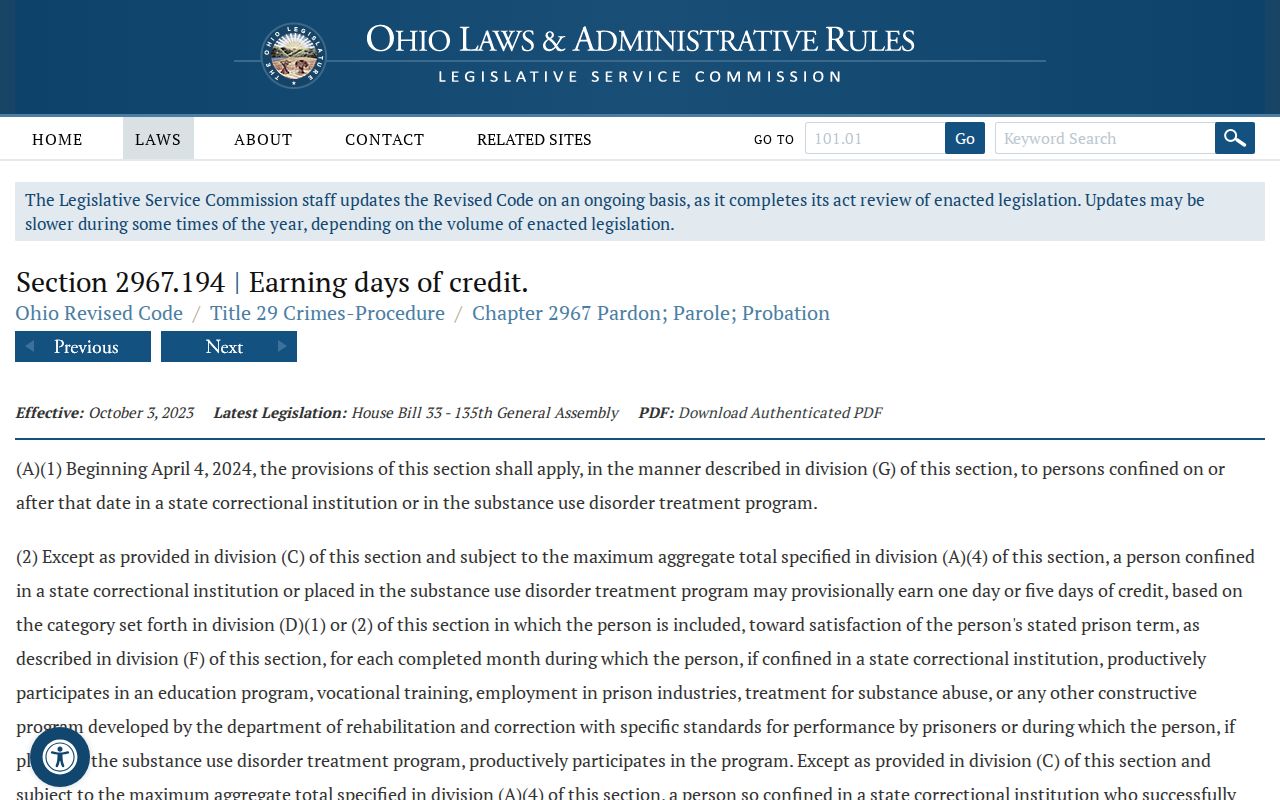
The statutory text is the source for the credit rules, but ODRC's official calculation controls the date for a particular prison record.
Credits are provisional and conduct-sensitive. They can be denied or withdrawn after review. Exclusions include mandatory or nonreducible terms, murder and related offenses, life without parole, certain special sentence structures, and specified sexually oriented offenses. Reagan Tokes indefinite terms have distinct minimum-and-maximum treatment. Historical law should not replace the current rule for a present calculation.
Miami County State Release Calculations
An ODRC calculation can combine definite, indefinite, mandatory, and consecutive sentence parts. Jail-time credit is time the court awards for qualifying confinement before the prison calculation. Earned program credit is different. Parole eligibility is different again, and judicial release is a court mechanism. A short docket view may not display the full sentence aggregation that ODRC uses.
Some earned credits apply to both the minimum and maximum of a qualifying indefinite term, while mandatory components may not be reduced. The Parole Board retains a separate role for parole-eligible sentences. A person can reach an eligibility date without receiving parole, or can have a favorable action that still requires conditions and release processing. If one sentence component ends while another hold remains, the result may be continued custody rather than community release.
- Definite sentence
- A fixed term stated by the court, subject to lawful credits and later orders.
- Indefinite sentence
- A sentence with minimum and maximum components governed by its statute and official calculation.
- Jail-time credit
- Court-awarded credit for qualifying time already spent in confinement.
- Earned credit
- Provisional statutory credit based on eligibility, participation, completion, and conduct review.
- Detainer
- A request or hold from another authority that can prevent release to the community.
When the arithmetic seems wrong, gather the signed judgments, credit entries, offender number, and the exact live ODRC label before asking for review. Do not accuse a source of error based only on subtraction. Credits, later orders, or a sentence component may not be visible in the summary at hand.
Note: Quote every ODRC date with its official label and query time because the research did not verify one universal future-date label.
Why Miami County Release Dates Change
A date can move even when the name and sentence appear unchanged. Some changes reduce the custody term, while others delay community release or convert it into a transfer. The source record should show which authority made the change. When the short docket summary and ODRC calculation look inconsistent, contact ODRC rather than reverse-engineering data that may omit sentence aggregation or later orders.
| Factor | Possible effect | Best confirmation |
|---|---|---|
| Jail-time credit | Credits time already served toward a sentence | Signed court entry and official calculation |
| Earned credit | May reduce an eligible ODRC term; can be denied or withdrawn | ODRC record and R.C. 2967.194 |
| Later court order | May alter credit, sentence, or authorize judicial release | Filed order and agency record |
| Detainer or warrant | Can prevent community release when one term ends | Holding and receiving authorities |
| Consecutive sentence | Adds another sentence component | Judgments and ODRC aggregation |
| Parole Board action | Eligibility or scheduling does not itself grant release | Official Board and ODRC records |
Parole eligibility under R.C. 2967.13 is its own milestone. A hearing date marks scheduling. A decision can include conditions and further steps. Physical release and later supervision discharge occur after that. Keep each date under its exact label.
Note: Eligibility, a scheduled hearing, a favorable decision, physical release, and final supervision discharge are separate dates.
Confirm Miami County Actual Release
Near the planned date, repeat the correct official search and contact the responsible agency. For county custody, call the jail and request the completed Sheriff release entry. For an ODRC sentence, open the official detail and confirm the date and status with ODRC. If the disposition says transfer or conveyance, follow the receiving authority rather than describing the person as free.
Ohio VINE can provide a person-specific custody event or alert for participating county jails and ODRC. It does not guarantee that every event is instant, and it does not cover BOP or ICE. The Miami County VINELink release check explains registration and event limits. Preserve an alert, then confirm it with the Sheriff or ODRC record.
Actual release is confirmed after processing, not by a projected date alone. A sound record names the person and custody episode, gives the exact agency wording, states the query time, and distinguishes community release from a move to another jail or prison.