
Miami County Inmate Release Meaning
A Miami County jail episode ends when the Sheriff's records system posts a disposition. The result may be bond or recognizance, dismissal, time served, completion of a county sentence, a community-control order, transfer to another jail, conveyance to the Ohio Department of Rehabilitation and Correction, pickup on a detainer, escape, death, or another agency term. Only some of those results place the person back in the community. The exact disposition matters more than the broad word “release.”
Miami County operates two Sheriff facilities. The downtown Miami County Jail handles full-service intake, release, and higher custody classifications. The Miami County Incarceration Facility, or MCIF, is a separate minimum-security and work-release setting. A person may move between those buildings without leaving custody. The public roster combines the provider under “MIAMI COUNTY JAIL,” so a building change can be hard to see from the public screen. A Sheriff booking and release entry is the best local record of the time and disposition. A court order explains the legal basis, while a receiving agency confirms a transfer.
- Release
- The end of one agency's custody episode, which may mean community return or transfer.
- Discharge
- An official end point in a sentence, custody, or supervision record, depending on the agency's wording.
- Time served
- A court outcome crediting custody already completed toward the ordered jail term.
- Detainer
- A request or hold that may move a person to another authority instead of the community.
Miami County Jail Release Types
The Sheriff's actual code or wording controls. A court docket can clarify why an event was authorized, but it may not show when jail staff completed identity checks, reviewed other holds, returned property, and processed the physical exit. The following distinctions keep a Miami County release search tied to the right source.
| Outcome | Meaning | Next record to check |
|---|---|---|
| Bond or recognizance | Pretrial release under court terms; the charge remains pending unless separately resolved. | CourtView order plus Sheriff release entry |
| Dismissal, acquittal, or no bill | A case result that may support release, though another case or hold can remain. | All relevant court cases and the jail disposition |
| Time served or sentence complete | The ordered custody part has ended; local supervision may still follow. | Sentencing entry, release record, and probation record where relevant |
| Judicial release or parole | A court or parole process changes prison custody under stated conditions. | ODRC record, court or Board document, and supervision status |
| Transfer or conveyance | Another jail, ODRC, or another authority receives the person. | Receiving agency's custody record |
| Detainer pickup | Miami County ends physical custody while another authority continues it. | Release disposition and the agency named as recipient |
Miami County Release Record Fields
Ask Miami County Sheriff Records for the booking and release record, any maintained jail movement or release-log entry, and the release-disposition field. A request may name desired fields, but that does not prove every field exists or is open. Staff should identify the responsive record, any redaction, the relevant fee, and the retention schedule. A booking photograph is best requested as a separate item.
| Requested field | What it can establish |
|---|---|
| Full name and booking number | Connects the release to the correct Miami County booking episode. |
| Admission date and time | Marks the start of the recorded jail episode. |
| Release date and time | Shows the Sheriff's maintained physical processing timestamp, when available. |
| Release disposition or reason | Distinguishes community release from transfer, conveyance, or another result. |
| Destination or receiving agency | Identifies the next custody system when the person did not go home. |
| Charge or case cross-reference | Connects the jail episode to the correct Municipal or Common Pleas file. |
| Booking photograph | Identifies the image for that booking, subject to records review and any quoted media cost. |
Can an old release still be requested after the online name disappears? Yes, the roster's current-only scope is separate from legal retention. Ask for the Sheriff's adopted RC-2 retention schedule if the age of the record matters. A removed web entry does not show that the source record was destroyed.
Note: Requesting a field tells Records what is sought, but it does not prove that Miami County maintains or can disclose it.
Request Miami County Release Records
Miami County Sheriff Records accepts requests through the county form, through the email linked on its records page, by phone, or in person. The office is at 201 West Main Street, Troy, OH 45373, and the records number is (937) 440-6085. Its posted hours are Monday through Friday, 8:00 a.m. to 4:00 p.m., excluding legal holidays. Ohio law calls for prompt inspection and copies within a reasonable period, but no fixed response day is promised.
- Identify the person and a narrow booking or date range. Include a booking number or another lawful identifier when known.
- Ask for the existing booking and release record, admission and release timestamps, disposition, and receiving agency or destination if maintained.
- Request the booking photograph separately. Ask for a cost estimate if media, mailing, or many pages may be involved.
- Prefer electronic copies and ask for all reasonably separable public portions if part of the record is withheld.
- If a field is unavailable, ask the office to identify the applicable exemption or retention schedule rather than asking staff to create a new report.
201 West Main Street
Troy, OH 45373
(937) 440-6085
Monday-Friday, 8:00 a.m.-4:00 p.m., excluding legal holidays
The Sheriff's posted rates are $0.05 for a single-sided hard-copy page and $0.10 for a double-sided page. Digital requests under 20 pages are listed at no charge; requests of 20 or more pages use the posted page rates and require prepayment. Photograph, video, other media, and mailing charges are quoted on request. These rates belong to Sheriff Records, not to the courts or ODRC.
Note: A narrow request for an existing release log is more effective than asking the office to build a custom report.
Ohio Law on Miami Releases
Ohio Revised Code 149.43 is the baseline public-records law. It generally permits prompt inspection and copies within a reasonable period at actual cost, subject to statutory exceptions. The law does not create a Miami County 24-hour feed, a 72-hour feed, or one statewide retention period. Juvenile, sealed, expunged, confidential investigatory, and protected personal material may be withheld or redacted. Probation, parole, and some supervision records also have express limits.
ODRC records follow a different rule. R.C. 5120.21 requires an institutional record with discharge information, yet makes the full inmate and APA file nonpublic. Limited categories may be disclosed, including a photograph and supervision status. A county request should go to the Sheriff; a court order should go to the Clerk; and an ODRC status or state-prison photo belongs with ODRC.
Sealing and expungement can change public visibility. Waiting periods may run from final discharge, which can occur after physical jail release if sentence or supervision duties remain. Current eligibility depends on the case and current law. An absent CourtView result may also reflect spelling, division choice, indexing, juvenile confidentiality, or portal limits, so absence alone does not erase the historical custody question.
Note: Ohio law and portal visibility can change, so use the statutory version in force when the record question arises.
When Miami County Releases Occur
Miami County's 2025 Jail Needs Assessment reviewed 2023 operations and found releases were highest from 7:00 a.m. through 4:00 p.m. That is historical workload evidence, not a release appointment, a daily guarantee, a weekend rule, or an instruction to wait at a particular door. The assessment discusses booking, intake, and release work but does not publish a family waiting area or property-return procedure.
A court order can be entered before the jail completes release processing. Staff may still need to verify identity, examine other cases and holds, complete internal records, and return available property. For a lawful pickup or time-sensitive concern, call inmate information at (937) 440-3961 or the relevant facility control. Do not infer an exit time from the roster's stated 30-minute update interval.
Travel After Miami County Release
Miami County Transit operates demand-response service rather than a fixed jail shuttle. Anyone may ride. The county states a $4 one-way fare within Miami County, prefers reservations 24 hours ahead, and does not guarantee same-day service. Scheduling is available at (937) 335-7433. Transit must be booked directly; no official source promises pickup at either jail.
The transit office address is near MCIF by road number, but proximity is not an exit plan. Ask the facility about the actual release point and property process for the specific episode, then coordinate travel with the provider. The official sources do not publish a standing ride, taxi arrangement, or guaranteed destination for a person released from Miami County custody.
Note: A transit reservation is separate from jail processing and does not confirm that Miami County has approved or completed release.
Miami County Bond Release Checks
Miami County publishes a Municipal Court bond schedule and also operates Common Pleas Pretrial Services. Pretrial officers screen defendants and provide bond reports and release-condition recommendations. A bond or recognizance order permits a pretrial release under court conditions; it does not mean a sentence was completed or the case ended.
Use the Court Services information to understand the local pretrial role, then read the signed order in CourtView. Pair that order with the Sheriff's release entry. One case can permit release while another case, warrant, or detainer keeps the person in custody. Checking all known case numbers is essential.
Miami County Release Trends
The official needs assessment supplies local context that the live roster cannot. Annual jail admissions ranged from 1,814 to 1,968 during 2021 through 2023. Average length of stay for people released during 2023 was 33.0 days, after a 38.4-day peak in 2022. These are historical system measures. They cannot estimate how long a named person will remain or when a current release will occur.
The same assessment discusses classification, intake and release workflow, and facility planning. Its planning figures must stay tied to that context. Physical beds, certified capacity, funded space, and recommended future capacity are not interchangeable current-population numbers.
Find Miami County Released Inmates
Start with the authority that last held the person. A county booking, an Ohio prison sentence, federal custody, and immigration custody each have different records. Use at least two compatible sources and note the time of each live query.
- For a Miami County episode, check the current-only roster. A match reports current custody at its latest timestamp; no match is only a lead.
- Call inmate information at (937) 440-3961 or the appropriate jail control and ask whether the person is held, moved, transferred, or released.
- Request the Sheriff's completed release record, then compare the disposition with every relevant CourtView case and signed order.
- For an Ohio prison episode, search ODRC using Released and APA Supervision separately. Miami as County of Commitment can help, but multi-county cases may be indexed under the first county.
- Use Ohio VINE for a person-specific custody event or alert, not as a permanent certified archive or a county-wide release list.
- Use BOP for federal custody and ICE ODLS for current or recent immigration custody. Confirm any transfer or other hold with the receiving authority.
For a same-day period request, specify exact start and end times when asking Sheriff Records for existing release-log entries. A named-person inquiry belongs first with the agency responsible for that custody episode.
ODRC Miami County Release Search
The Ohio Department of Rehabilitation and Correction Offender Search covers people in Ohio prisons, under Department supervision, or judicially released. It does not cover every person who left Miami County Jail. Search Released for former ODRC custody and APA Supervision for parole, post-release control, or related state oversight. Use an offender number when possible, then compare the name, commitment county, offense, and other lawful identifiers.
| Search field | How Miami County users apply it |
|---|---|
| Last and first name | Use the known spelling; last-name search behaves like a prefix search. |
| County of Commitment | Select Miami for a sentence originating here, while allowing for first-county indexing in multi-county cases. |
| Status | Run Released and APA Supervision separately; Violators at Large is a narrow wanted subset. |
| Offender number | Use the A, R, or W prefix plus six digits without spaces or hyphens; some five-digit female numbers need a leading zero. |
| Residential county or ZIP | Use only for APA or violator searches; it is a last-recorded value, not a live location. |
| Next Board hearing date | Enter a YYYYMM value to find people scheduled for that month, not to prove a release decision. |
The official ODRC search screen shows these statewide controls.
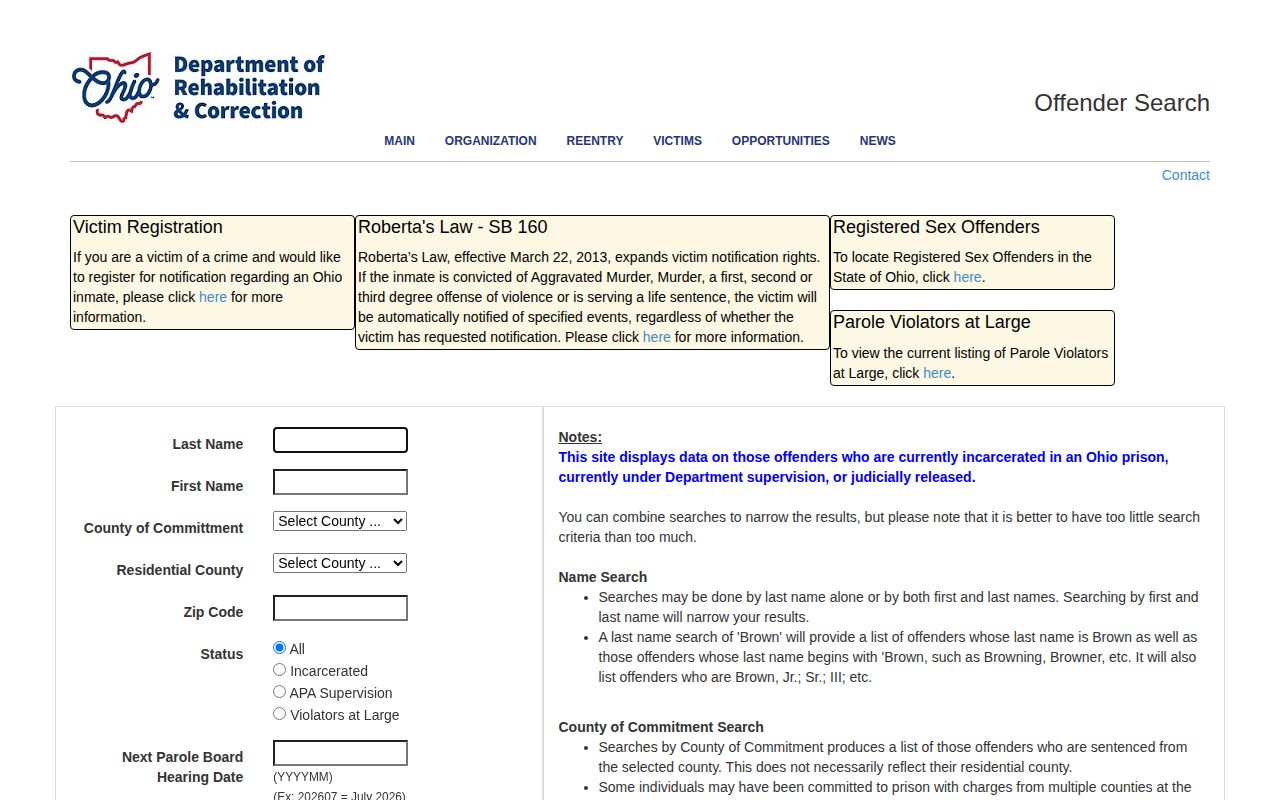
Read the exact status and date labels on the selected record. The research did not verify one universal label for an estimated release date, so the live wording should be copied rather than guessed.
Note: County of Commitment identifies sentencing origin, while Residential County is a limited APA search field and not a live address.
Miami County Current Roster Limits
The Miami County JusticeWeb roster calls itself “Persons Currently In Custody.” It provides first-name and last-name controls, A through Z browsing, a provider name and code, a telephone number, a latest timestamp, and a stated 30-minute update frequency. No official released archive, 24-hour filter, 72-hour filter, release date, or release disposition was found as of July 31, 2026. Captcha also prevented reliable confirmation of detail fields and photographs.
The captured official landing page illustrates the current-only scope and timestamped update model.
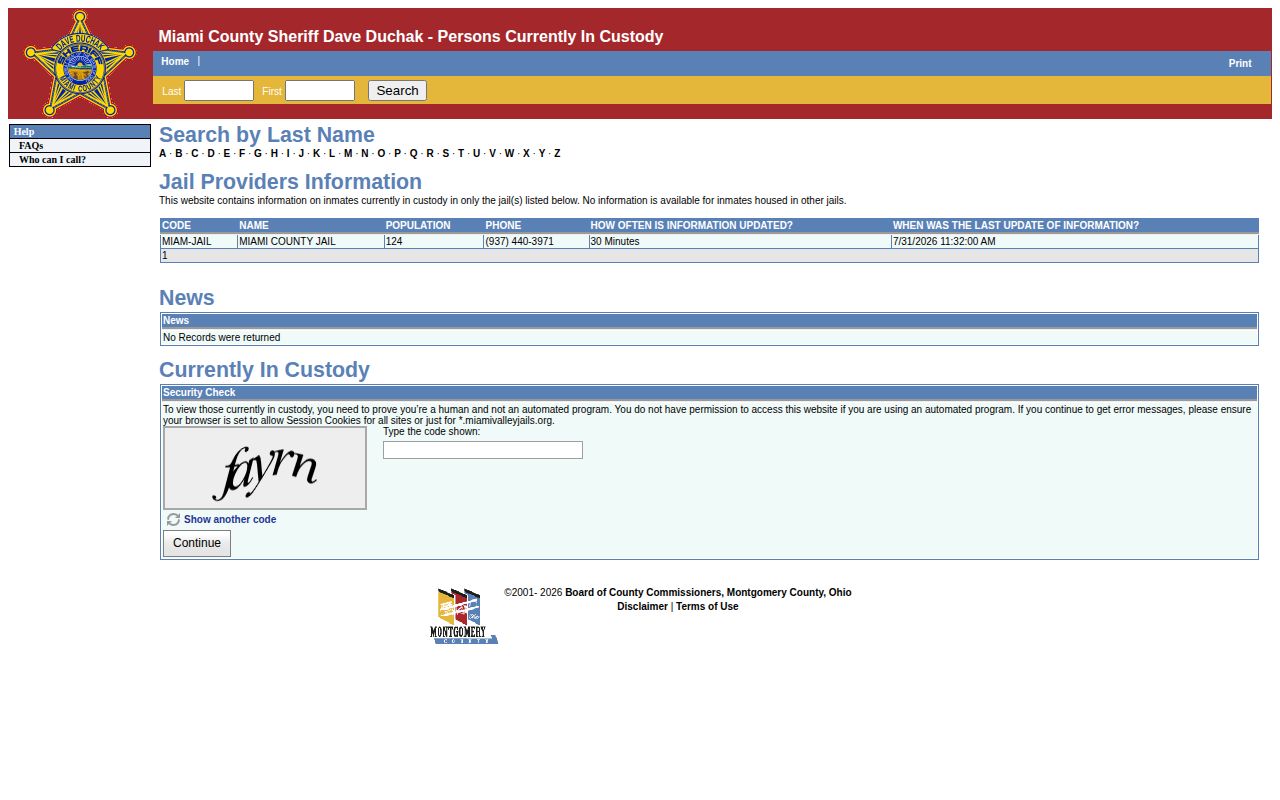
If a name vanishes, save both query times and call. The 30-minute statement is the provider's update interval, not a promise that each event appears within exactly half an hour. A historic release requires the source record.
Note: No official Sheriff inmate-release app was found; ICS Mobile is for visitation and is not a release roster.
Miami County Court Release Records
The Miami County Clerk maintains both Common Pleas and Municipal records, and the county directs users through one public-access gateway. Division choice still matters. Common Pleas handles felony dispositions. Municipal Traffic and Criminal handles misdemeanors, traffic cases, and preliminary matters. A municipal case that ends or moves can be followed by a Common Pleas indictment, so one search result may not resolve every hold.
Review the caption, identity, every known criminal case number, entries around the claimed release, the signed order, bond information, sentencing and jail-credit language, warrants or capiases, supervision entries, and conveyance language. CourtView is a convenience copy; the Clerk holds the official record. A certified court order proves the document, not the minute when the Sheriff completed physical release.
Note: A Municipal dismissal may precede a Common Pleas case, so search both divisions before treating the court history as complete.
Miami County Supervision After Release
County probation and state supervision are separate. Miami County Common Pleas created its Adult Probation Department in 2020. Its court-ordered community control is verified through the docket, judgment entry, and appropriate public confirmation from the local department. ODRC's APA Supervision status covers parole, post-release control, and related state oversight. The Violators at Large search is limited to people APA reports wanted for alleged supervision violations.
A person can be Released from prison yet remain under APA supervision. Conversely, absence from an APA result does not rule out Miami County probation. County supervision must be checked through the court route, while state supervision belongs with ODRC and APA. Supervision notes and case-management files are not broadly public merely because the docket is open.
Miami Release Alerts and Federal Records
Ohio VINELink covers participating county jails, ODRC, and the Department of Youth Services. It can support a person-specific search and release, transfer, escape, or death notification. A VINE event is not a certified permanent release record. Confirm a Miami County event with the Sheriff, a state event with ODRC, and any transfer with the receiving agency.
Federal and immigration custody require separate tools. The BOP Inmate Locator covers federal inmates from 1982 forward and can show a release date or “Not in BOP Custody.” That wording only ends BOP custody; another agency or federal supervision may remain. ICE ODLS covers current or recent immigration custody, and a missing result can reflect delay, spelling, withholding, or scope. No federal prison, ODRC prison, ICE detention facility, or current ICE contract was verified within Miami County.
Note: Ohio VINE does not cover BOP, ICE, or USMS custody simply because the person has a Miami County connection.
Miami County Custody Source Comparison
Use each portal only for the question it was built to answer. Mixing a current roster with a past release query produces false certainty.
Miami JusticeWeb: Use it for reported current Sheriff custody at the displayed update. It has no verified released archive or release fields.
Sheriff release record: Use it for the county booking end time, disposition, and destination if maintained. A request is needed, and fields or redactions can vary.
CourtView: Use it for bond, dismissal, sentence, time served, community control, judicial release, or conveyance orders. A legal order is not a physical-exit timestamp.
ODRC search: Use it for Ohio prison release and state supervision status. It does not cover routine county-jail releases.
Ohio VINE: Use it for a person-specific event and notification. It is not a certified permanent ledger.
BOP or ICE: Use each for custody within its federal scope. A no-custody result does not rule out another authority.
Miami County Jail Movement History
Miami County's two-jail history helps explain why a building absence is not enough. The downtown facility dates to 1972. MCIF opened in 1999 after a federal overcrowding consent decree, closed during the 2009 recession, and reopened in 2013 as a minimum-security facility. Its history includes work-release and weekender functions. Historical plans for contracted populations do not prove a current federal or immigration arrangement.
Movement between downtown and MCIF is one reason to request the release disposition instead of treating a building absence as a community return. The receiving facility, court order, and Sheriff movement entry resolve different parts of that question.
Miami County Release Assessment Evidence
The 2025 Jail Needs Assessment is an unusually broad Miami County source. It brings admissions, average stay, custody classification, hour-of-day release patterns, intake and release workflow, and facility replacement evidence into one official study. That combination supports local context without turning planning findings into live operational facts.
Assessment figures must remain tied to their labels and study period. A planning capacity is not the same as certified capacity, funded operating space, or today's population. Likewise, a historic peak release period does not create a release appointment. The assessment does not provide a public recent-release feed. Facility control and Sheriff Records remain the sources for a named episode.
Note: Planning findings provide local context, but a current custody or release claim still needs a live agency record.
Miami County Release Facilities
Both facilities are Sheriff-operated, but their roles differ. Use the facility page for contact details, custody type, release confirmation, and the correct records path.
- Miami County Jail: downtown full-service booking, intake, release, and higher-classification custody; a departure may be community release, transfer to MCIF, another jail, or ODRC.
- Miami County Incarceration Facility: minimum-security and work-release custody; departure may mean completion, court-authorized release, return to another custody setting, or agency transfer.
For either building, obtain the Sheriff's release disposition and pair it with the court order when the legal basis matters. Follow any named receiving agency. A roster absence by itself cannot identify where the person went.